


Calendula: Calendula officinalis, Bride of the Sun and Cocktail Colour
At a glance: Calendula, Calendula officinalis, is the edible “Bride of the Sun”: a golden flower used in food, folklore, colour, skincare traditions, and cocktail garnish. At Trolley’d, its best role is vivid edible petal, botanical tincture inspiration, and sunlit storytelling, not medical overclaiming.
Last updated: May 2026. Written for Trolley’d’s foraging and sustainable cocktail library.
Cabin Note from Trolley’d
This guide is part of Trolley’d’s wider foraging and botanical education series. Calendula is a strong hospitality plant because it delivers colour, edible petals, culinary history, folklore, and approachable safety compared with many wild botanicals.
The correct Trolley’d position: calendula as edible flower, garnish, colour, tincture inspiration, and botanical theatre. Avoid turning traditional wound, skin, digestive, or anti-inflammatory uses into health promises.
Golden bride of the morning sun,
A petal of fire when the day has begun.
Calendula: The Bride of the Sun
Calendula officinalis, also known as pot marigold, common marigold, Marygold, and Bride of the Sun, is a flower that looks as though it has been drinking daylight. Its petals burn in orange, yellow, and gold, and the whole plant carries the old-world glamour of cottage gardens, apothecaries, Roman kitchens, and folklore.
At Trolley’d, calendula belongs because it has immediate event value. It is edible, recognisable, visually rich, and easy to explain. Guests understand the sunlit colour before they understand the chemistry. That is useful. A flower that can make a drink look brighter before anyone takes the first sip has earned its boarding pass.
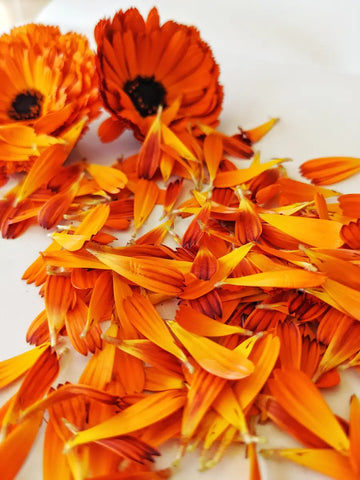
Calendula brings edible colour, garden theatre, and sunlit botanical storytelling into the glass.
Safety Before Takeoff: Edible, But Watch the Daisy Family
Calendula petals are widely used as edible flowers. The main caution is allergy. People sensitive to the Asteraceae family, also known as the daisy family, should be cautious around calendula and related plants.
For Trolley’d, the sensible service position is simple: use cleanly grown petals, avoid chemically treated flowers, avoid presenting calendula as medical treatment, and clearly distinguish Calendula officinalis from ornamental Tagetes marigolds, which are also commonly called marigold.
Botanical Boarding Pass
Scientific name: Calendula officinalis.
Common names: Pot Marigold, Common Marigold, Riddles, Scotch Marigold, Garden Marigold, Marygold, Ringblomma, Galbinele.
Folk names: Bride of the Sun, Drunkard, Goldes, Holigolde, Husbandman’s Dial, Marybud, Mary Gowles, Ruddes, Riddles, Spouse Solis, Summer’s Bride.
Botanical family: Asteraceae, the daisy family.
Native habitat: Commonly associated with central and southern Europe and western Asia, and now cultivated widely in gardens around the world.
Name note: The Latin officinalis often refers to plants historically associated with medicine, herbalism, or cookery.
Culinary Uses: Poor Man’s Saffron and Petals of Gold
Calendula petals have a long culinary history. In ancient Rome and later European kitchens, the petals were used to colour food and as a more accessible substitute for saffron, giving rise to the phrase “poor man’s saffron.”
The petals can be used in salads, butters, rice dishes, soups, cakes, teas, cordials, and drinks. Their main strength is not a huge flavour punch. It is colour: gold, orange, and yellow that immediately make food and drink feel more alive.
The leaves are technically edible, but they are not the best part of the plant and are not especially delicious. For Trolley’d, the petals are the hero.
How Calendula Lands in a Trolley’d Cocktail
Calendula’s cocktail value is colour, ceremony, and solar mythology. It is not a garnish that needs explaining for long. The drink arrives, the petals glow, and the guest understands the point.
First-Class Uses
- Fresh petal garnish: bright, edible, easy to scale, and visually warm.
- Dehydrated petals: useful for rims, teas, tinctures, and colour-led garnish blends.
- Calendula tincture or infusion: worth testing for colour, bitterness, aroma, and stability.
- Spritz and champagne serves: petals work beautifully in bubbles, citrus, and lighter botanical drinks.
- Solar storytelling: “Bride of the Sun” gives the drink a poetic hook without needing false health claims.
The discipline is to keep it elegant. Calendula should look intentional, not like someone emptied a craft drawer onto a cocktail.
Traditional Uses: Respect the History, Don’t Sell the Cure
Calendula has a long history in Western herbalism. Traditional uses include skin preparations, wound washes, swelling, digestive discomfort, and menstrual applications. Nicholas Culpeper described marigold as an herb of the sun and associated it with Leo.
The original source material lists traditional uses for inflamed skin, wounds, jaundice, constipation, varicose veins, Crohn’s disease, colitis, gastritis, haemorrhoids, and other conditions. Those belong in an ethnobotanical or herbal-history context, not as promises on an event company’s cocktail page. :contentReference[oaicite:1]{index=1}
That is not weakening the page. It is strengthening it. A premium brand does not need to sound like a supplement bottle.
Phytochemistry: Carotenoids, Flavonoids and Golden Pigment
The main compound groups discussed in calendula include terpenoids, flavonoids, coumarins, quinones, volatile oils, carotenoids, and amino acids. The vivid orange and yellow pigments are connected to carotenoids, which explains calendula’s long use as a dye for food, fabric, cosmetics, and ornamental purposes.
Calendula extracts have been studied for various biological activities, but those studies should not be turned into casual claims that a cocktail garnish treats disease. For Trolley’d, the phytochemical value is colour, aroma, and story.
History: Little Calendar, Marygold and the Sun’s Flower
The name calendula is often linked to the Latin calendae, the first day of the month, because the plant was associated with repeated blooming. The flower also became known as Marygold or Marybud in Christian tradition because it bloomed around festivals celebrating the Virgin Mary.
Calendula has been called the herb of the sun because the flowers open in the morning and close in the evening. Shakespeare mentions marigold in The Winter’s Tale, and European folklore used the flower as a weather sign: if the blooms remained closed after morning, rain was expected.
The flower’s symbolic trail runs through Roman kitchens, Greek myth, Christian festival culture, Indian sacred use, German weather lore, Spanish sorcery, and medieval love magic. It is absurdly rich for a flower that also looks good on a spritz.
Powers, Folklore and the Forbidden Flying Bench
Calendula’s magical history is almost too good. Petals under the bed were said to protect sleepers and bring true dreams. Flowers on doorposts were used to keep evil away. A calendula bath was believed to help win respect and admiration.
One of the stranger stories comes from Dr. Johannes Hartlieb’s fifteenth-century writing on forbidden arts, where calendula appeared in a witches’ ointment associated with flying benches, chairs, rakes, or pitchforks. The source also mentions a sixteenth-century belief that drinking a potion of marigolds could bring visions of fairies. Keep that exactly where it belongs: folklore, not fact.
Want Edible Flowers in the Glass?
Trolley’d creates edible flower cocktail classes, botanical drink experiences, and aviation-themed hospitality for private events, corporate activations, and selected destination experiences. Calendula brings colour, folklore, and sunshine to the glass when handled with restraint.
Calendula FAQ
What is calendula?
Calendula, Calendula officinalis, is an edible flowering plant also known as pot marigold, common marigold, Marygold, and Bride of the Sun. It is known for golden-orange petals, culinary colour, traditional herbal use, and strong folklore around the sun.
Are calendula flowers edible?
Yes. Calendula petals are commonly used as edible flowers in salads, rice dishes, cakes, teas, butters, cocktails, and garnishes. The petals are the best culinary part. The leaves are edible but not especially tasty and are not the hero for Trolley’d cocktail use.
Is calendula safe?
Calendula is widely used as an edible flower, but people with allergies to the Asteraceae or daisy family should be cautious. Trolley’d should use cleanly grown, food-safe petals and avoid chemically treated flowers. Medicinal use should not be implied through cocktail service.
Is calendula the same as marigold?
Calendula is often called pot marigold or common marigold, but it should not be confused with Tagetes marigolds. They are different plants. For food and drink use, correct identification matters. The page refers specifically to Calendula officinalis.
What does calendula taste like?
Calendula petals are usually mild, slightly bitter, earthy, peppery, and sometimes compared with saffron as a colour and culinary accent. Their main cocktail value is visual warmth and golden colour rather than intense flavour.
Can calendula be used in cocktails?
Yes. Calendula petals work well as fresh garnish, dehydrated garnish, infusion, tincture inspiration, floral ice cube, or garnish blend. They pair well with citrus, gin, sparkling wine, honey, chamomile, lemon myrtle, and lighter garden-style drinks.
Why is calendula called Bride of the Sun?
Calendula is associated with the sun because its golden flowers open during daylight and close in the evening. Folk names include Bride of the Sun, Summer’s Bride, and Spouse Solis. These names give the plant strong storytelling value in botanical cocktails.
Can I book an edible flower cocktail class with Trolley’d?
Yes. Trolley’d hosts cocktail-making classes that can include edible flowers, native botanicals, seasonal ingredients, wild food stories, garnish technique, and non-alcoholic cocktail structure. These suit private groups, hens parties, corporate teams, and experience-led celebrations.
Glossary
Terpenoids: Plant compounds that contribute to aroma, flavour, colour, and plant defence.
Flavonoids: Plant compounds widely studied for antioxidant and anti-inflammatory properties.
Coumarins: Aromatic plant compounds often described as having hay-like, vanilla-like, or sweet notes.
Quinones: Plant-derived secondary metabolites studied in pharmacology and natural products chemistry.
Volatile oil: Aromatic plant compounds that evaporate readily and are often referred to as essential oils.
Carotenoids: Plant pigments responsible for many yellow, orange, and red colours in flowers, fruits, and vegetables.
Amino acids: Organic compounds used by living organisms to build proteins and other essential biological molecules.
Acknowledgments and Sources
- Kirtikar, K.R. and Basu, B.D. Indian Medicinal Plants, Vol. II, International Book Distributor, 1993, pp. 1413–1414.
- Khare, C.P. Encyclopedia of Indian Medicinal Plants, Springer-Verlag, 2004, pp. 116–117.
- Muley, B.P., Khadabadi, S.S. and Banarese, N.B. 2009, Tropical Journal of Pharmaceutical Research, pp. 455–465.
- Chevallier, A. Encyclopedia of Herbal Medicine, Dorling Kindersley, 1996, p. 73.
- Easley, T. and Horne, S. The Modern Herbal Dispensatory, North Atlantic Books, 2016, pp. 200–201.
- Simmonds, M., Howes, M.J. and Irving, J. The Gardener’s Companion to Medicinal Plants, Royal Botanic Gardens Kew, 2016, pp. 42–43.
- Cunningham, S. Encyclopedia of Magical Herbs, Llewellyn Publications, 1985, p. 169.
- Rätsch, C. The Encyclopedia of Psychoactive Plants, Park Street Press, 1998, p. 801.
- Herbalpedia, The Herb Growing & Marketing Network, 2016, Calendula entry.
- Panche, A.N., Diwan, A.D. and Chandra, S.R. 2016, Journal of Nutritional Science, 5, PMC5465813.
- Basu, C. 2019, Medicinal Plants Journal, Springer Nature Switzerland AG, pp. 333–359.
- Venugopala, K.N., Rashmi, V. and Odhav, B. 2013, ‘Review on Natural Coumarin Lead Compounds for Their Pharmacological Activity’, BioMed Research International, Article ID 963248.
- Lu, J.J. et al. 2013, ‘Quinones derived from plant secondary metabolites as anti-cancer agents’, Anticancer Agents in Medicinal Chemistry.
- Wang, X.D. 2014, ‘Carotenoids’, in Modern Nutrition in Health and Disease, 11th ed., Lippincott Williams & Wilkins, pp. 427–439.
Trolley’d is an Australian experiential hospitality company founded by Byron Woolfrey, deploying premium aviation assets with foraged botanical cocktails for Sydney events and selected destination activations.


32 comments
All thanks to doc excel for bringing my life back to normal because I just got cured from Herpes virus 1&2 with the herbal medicine that he sent me to drink. I got to know about doc excel through a friend that was cured from genital herpes with the same medicine. His herbal medicine works magic without any side effects. I would recommend Him to everyone suffering from any type of herpes virus. You can contact him through His web address: https://excelherbalcure.com and his WhatsApp number +1 509 883 9893
I’m still trying to process the fact that I have just been cured from herpes virus because my medical doctor just confirmed me negative after having the virus for more than five years. I still remember how I got the virus back then from my cheating boyfriend and we actually broke up because of it but now I have just been cured after I finish drinking the herbal meds that were prepared and ship to me by a herbal man called excel who I contacted through his website. Get to know about this herbal man and his herbal medication on his website https://excelherbalcure.com
Dear friends online My name is Destiny Hudson And I live in the USA, Dominica I am here today to appreciate the good work of Dr Oyagu, for helping me curing my HSV 1&2 Disease, I contacted the virus from my Partner, I found out he was cheating on me, so i broke up with him, 2 month later I went to test myself in the hospital when I was seeing sore on my mouth and Private areas, I was diagnosed of HSV 1&2. I tried using the acyclovir medicine but it didn\’t help in curing it, I went on a search and found out Dr Oyagu curing people illness, and so I got his email and I was told how I can get his herbal cure, 3 days later I received his medicine after using it for 2 weeks I was tested again and was confirm negative, today I am totally free. If you are over there looking for solution email: oyaguherbalhome@gmail.com or contact him on WhatsApp +2348101755322 today and share your own testimony. And He also has herbal cure for the Following DISEASES, eczema, urethra wart, chronic problems. Herpes, Cancer, Als, Hepatitis, Diabetes, HPV ,Infections, ulcer ETC https://oyaguspellcaster.wixsite.com/oyaguherbalhome
I’m a testament that miracles happens. When I turned 18, My grandfather encouraged me to buy a lottery ticket for fun but I wasn’t pleased with the way I kept on playing without winning. I was eager to learn more about how to win the lottery and when I searched the internet I found numerous articles saying how they won the lottery through his spells and I decided to give it a try by contacting Lord Meduza.
I’d love to say that this man is such a sweet soul who got my back all through the process of making me a lottery spell to win the lottery. The numbers he gave me won me the LOTTO 6/49 Gold Ball of a whopping $48,000,000 Million Canadian Dollars. Right now, my family and I are blessed. Thank you LORD MEDUZA for making this win come true for me and my family. Anyone that seeks for his help can go to his website: lordmeduzatemple.com or Email: lordmeduzatemple@hotmail.com or Whats_App: +1 807 798 3042 for more details about his works.
I have promised to tell the whole world that natural herbal medicine can cure the herpes virus and I’m so happy with my life now because I have totally got cured from the virus after I finish drinking the herbal medicine from a herbalist called doctor excel. he prepared and sent me the meds to drink and now I have tested negative several times since after. you can get to know this herbal man on his website: Excelherbalcure.com