


Mulberries: History, Health, Folklore and Cocktail Uses
At a glance: Mulberries are more than backyard fruit. They carry silk road history, medicinal tradition, folklore, culinary value, and real cocktail potential. At Trolley’d, they sit perfectly in our world of foraged ingredients, native botanicals, sustainable bar craft, and drinks that give guests something worth talking about.
Last updated: May 2026. Written for Trolley’d’s foraging and sustainable cocktail library.
Cabin Note from Trolley’d
This guide is part of Trolley’d’s wider foraging and cocktail education series. Our work connects wild ingredients, native botanicals, sustainable preparation, and aviation-themed event theatre. The aim is not to encourage reckless picking. It is to show how ingredient knowledge can become a better drink, a better story, and a better event.
Important: Always identify plants with certainty before eating or using them. Ripe mulberries are commonly eaten, but unripe fruit, sap, leaves, extracts, and medicinal preparations should be treated with caution.
Mulberries: The Sweet, Stained, Slightly Dangerous Passenger
Ah, the mulberry, Morus to its botanist admirers and a tree of contradictions. For a fruit that looks so harmless, these berries hold stories, history, and even a bit of danger beneath their glossy skins. You may know them from nursery rhymes or lazy summer afternoons, but what you might not know is that mulberries have wandered through the histories of Asia, Europe, and North America, draping themselves in myth, medicine, silk, and scandal.
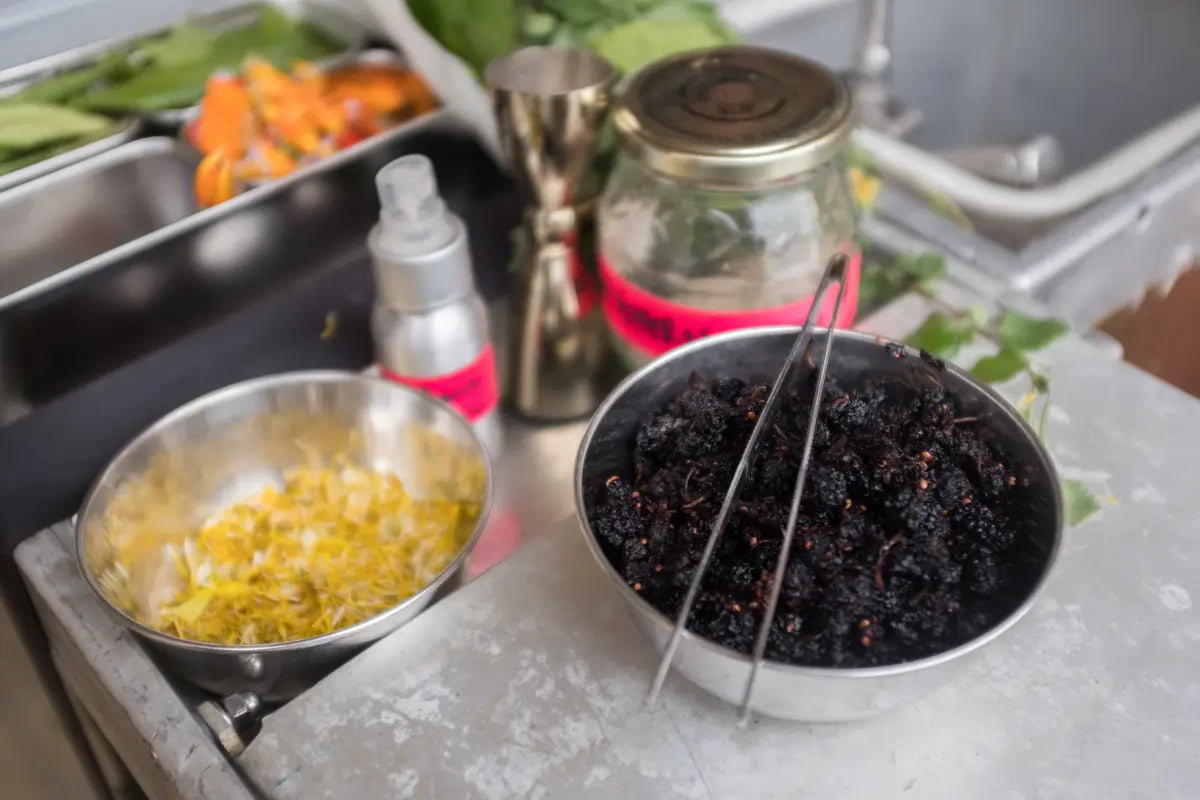
Foraged mulberries and native botanicals prepared for Trolley’d’s sustainable cocktail program.
The mulberry isn’t just one plant but a rather promiscuous genus, most notably comprising Morus alba, white mulberry, Morus rubra, red mulberry, and Morus nigra, black mulberry, along with various hybrid cultivars. The origins are as diverse as their colour palette: Morus alba hails from India, Morus rubra from eastern and central North America, and Morus nigra from Southwestern Asia and the Iberian Peninsula.
White mulberries, imported to North America in a bid to foster silk production, long ago abandoned their original brief. Like any unruly traveller with a taste for independence, they escaped into the wild and started dotting suburban neighbourhoods across the continent.
Safety Before Takeoff: What to Know Before Eating Mulberries
Ripe mulberries are widely eaten and used in jams, drinks, syrups, wines, desserts, and preserves. The caution sits elsewhere. Unripe green mulberries and the white sap in stems and leaves may cause nausea, indigestion, and other unpleasant effects if consumed in quantity.
Mulberry leaf extracts are also not the same thing as eating ripe fruit. They have been studied for medicinal and metabolic effects, but extracts can interact differently with the body depending on dose, preparation, health status, and individual sensitivity. Do not treat online plant notes as medical advice.
Of course, with mulberries, it is not all benevolent berries and sweet silk. The unripe fruit and the white, milky sap lurking in the leaves have a darker side. Those who nibble carelessly on unripe berries may be met with an unexpected gastrointestinal symphony, thanks to the alkaloids hiding within their verdant folds.
It is hard to deny the allure of mulberries, though. Traditional Chinese medicine has employed every part of the mulberry tree, including the root bark, leaves, and fruit, to treat ailments ranging from fevers and coughs to hypertension and high blood sugar. These little berries are antioxidant powerhouses, carrying anthocyanins, polysaccharides, and flavonoids that have attracted serious scientific interest.
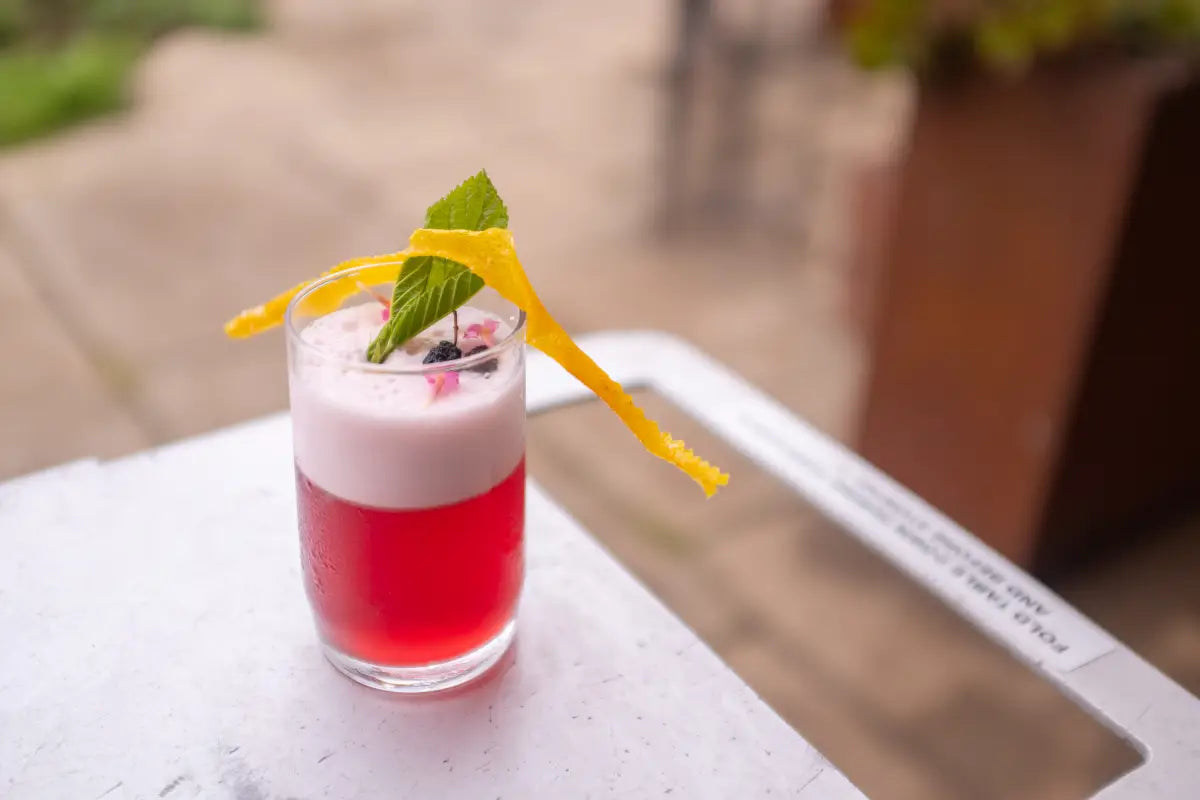
Mulberry works beautifully in syrups, shrubs, sours, spritzes, and native botanical cocktails.
How Mulberries Land in a Trolley’d Cocktail
Mulberries work beautifully because they give colour, acidity, nostalgia, and depth without needing to shout. They can behave like blackberry, plum, red wine, jam, and forest fruit depending on ripeness and preparation.
First-Class Uses
- Mulberry syrup: ideal for spritzes, sours, Collins-style drinks, and non-alcoholic cocktails.
- Mulberry shrub: fruit, sugar, and vinegar for sharp, bright, food-friendly drinks.
- Mulberry garnish: visually rich, seasonal, and far more memorable than another dehydrated citrus wheel.
- Mulberry native botanical spritz: excellent with lemon myrtle, river mint, wattleseed, quandong, or sparkling wine.
- Mulberry sour: strong for cocktail classes because it teaches balance, colour, acidity, foam, and garnish.
For events, the power of mulberries is not only flavour. It is the story. Guests remember a drink when it has a sense of place, season, and craft.
In one remarkable study, Morus alba leaf extracts demonstrated a unique ability to aid weight management, reduce fat accumulation, and improve insulin sensitivity by enhancing the activity of brown adipose tissue. Researchers found that the active compound 1-deoxynojirimycin not only helped control glucose metabolism but also modulated gut microbiota, offering a compelling reason to consider mulberry leaves as more than just silkworm fodder.
Silk, Paper, Myth and Scandal: The Mulberry’s Flight Log
Now let’s leave the lab coats behind and enter the rich, velvet folds of history. Mulberries have long played supporting roles on the stage of civilisation. In Ancient China, the white mulberry leaf became the preferred diet of silkworms, and thus the unlikely hero in the drama of the silk trade, a fabric so enchanting it lured traders along the Silk Road and turned emperors into fashion enthusiasts.
The Japanese took their fascination further by crafting Tengujo, the thinnest paper in the world, from mulberry stems. It is a craft so delicate you can see through its tissue-thin surface, a testament to how Morus has wound itself into the cultural tapestry of Asia.
Mulberry trees also became a symbol of doomed love in Ovid’s Metamorphoses. Pyramus and Thisbe, the original star-crossed lovers, met their fate under a mulberry tree, their spilled blood forever staining the once white berries a deep, tragic red.
Perhaps the mulberry’s most sobering historical footnote is modern. In 2021, Lori McClintock, wife of U.S. Representative Tom McClintock, fell ill after ingesting white mulberry leaf. Her death, linked in a Sacramento County coroner’s report to dehydration and gastroenteritis associated with white mulberry leaf ingestion, remains a cautionary tale of this plant’s dual nature.
Beyond the science and stories, mulberries are also delicious. Black mulberries, with their complex, tart sweetness, are perfect for jams, wines, jellies, syrups, shrubs, and summer cocktails. They make a beautiful addition to a glass, their deep hues swirling like a Monet painting in motion. At Trolley’d, we love to use mulberries as both ingredient and garnish, an edible ode to their tenacity, flavour, and the history they carry within their juice-stained skins.

Botanical Boarding Pass
Scientific name: Morus spp.
Common names: White mulberry, red mulberry, black mulberry.
Folk names: Tut, Morera, Gelso.
Botanical family: Moraceae.
Native habitat: M. alba, India. M. rubra, eastern and central North America. M. nigra, Southwestern Asia and the Iberian Peninsula.
Toxicity and allergens: Unripe green mulberries and white sap in the stem can cause indigestion and nausea if eaten in large amounts. White mulberry leaf extract may cause gastrointestinal distress depending on the person and amount consumed.
Traditional Uses, Phytochemistry and Cultural Notes
Traditional uses: Mulberries are prevalent in Chinese medicine. Root bark, leaves, and fruit have traditionally been used for fever, cough, hyperlipidaemia, hypertension, and hyperglycaemia.
The fresh fruits can be used in juices, wines, jams, jellies, syrups, desserts, and many other culinary preparations. Mulberry leaf extracts have been used possibly as far back as 4000 years ago in Ancient China, with modern research exploring effects on body weight and blood glucose.
Phytochemistry: The prominent functional compounds in mulberries include anthocyanins, polysaccharides, polyphenols, alkaloids, and flavonoids, all bioactive compounds involved in a variety of physiological processes. The 1-deoxynojirimycin, flavonoids, and polyphenols found in mulberry leaves are likely responsible for many of the reported metabolic effects studied in the literature.
History: Mulberry bark was used by Buddhist monks during the Angkorian Age of the Khmer Empire of Southeast Asia to make paper, which was in turn used to make books known as kraing. The Japanese use kozo, the stems of mulberry trees, to make Tengujo, the thinnest paper in the world. The traditional Romanian plum brandy Țuică has also been aged in barrels made from mulberry wood.
German folklore holds that the mulberry is evil because the devil cleans his boots with mulberry roots. Mulberry trees also appear in Vincent van Gogh’s paintings, most notably Mulberry Tree from 1889. In Ovid’s Metamorphoses, a mulberry tree features in the myth of Pyramus and Thisbe, where the fruit’s reddish-purple colour is attributed to the lovers’ blood staining the previously white berries.
Powers and magical uses: In folklore and magical herb traditions, mulberry has been associated with protection, dream work, and warding. Mulberry wood has been described as a protectant against evil, while mulberry leaves appear in traditions connected to psychic dreams and protective sigils.
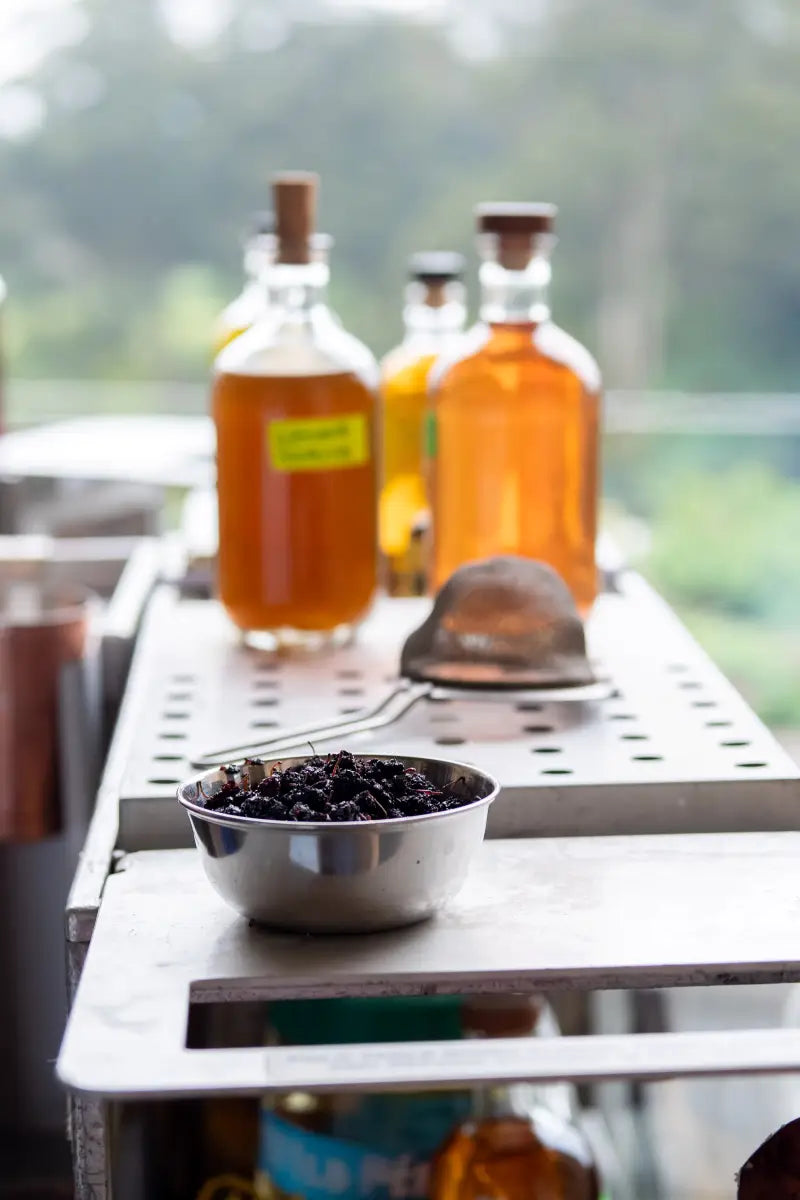
Foraged mulberries ready for takeoff in Trolley’d’s eco-luxury mobile bar program.
Want the Mulberry Story in the Glass?
Trolley’d creates foraged cocktail experiences for private events, cocktail classes, corporate activations, and aviation-themed celebrations. We turn seasonal fruit, wild ingredients, and native botanicals into drinks with a story, not just another garnish on autopilot.
Mulberry FAQ
Are mulberries edible?
Ripe mulberries are commonly eaten and used in jams, jellies, wines, syrups, desserts, and drinks. The key word is ripe. Unripe green mulberries and the white sap in stems and leaves can cause nausea and digestive discomfort, especially if consumed in quantity. If you are not certain of the plant identification or ripeness, do not eat it.
Can mulberries be used in cocktails?
Yes. Mulberries are excellent in cocktails because they bring colour, fruit depth, acidity, and a nostalgic berry character. They can be made into syrups, shrubs, reductions, cordials, garnishes, or muddled fruit components. At Trolley’d, they work particularly well with lemon myrtle, river mint, quandong, sparkling wine, gin, rum, and zero-alcohol botanical serves.
What do mulberries taste like?
Black mulberries are usually rich, tart, and jammy, somewhere between blackberry, plum, and red wine. Red and white varieties vary by ripeness and cultivar. The best cocktail use depends on the fruit’s balance of sweetness and acidity. Very ripe fruit can become soft and lush, while slightly sharper fruit can make better syrups and shrubs.
Are mulberry leaves safe?
Mulberry leaves have a long history of use and have been studied for metabolic effects, but that does not mean casual use is risk-free. Leaf extracts are concentrated preparations and may affect people differently. The safest culinary entry point is ripe fruit, not leaf extract. Anyone with medical conditions, medication use, pregnancy, or sensitivities should seek professional health advice before using medicinal preparations.
What native Australian botanicals pair with mulberry?
Mulberries pair well with lemon myrtle for lift, river mint for freshness, wattleseed for roasted depth, quandong for tart native fruit character, and native thyme for savoury structure. The best pairing depends on the drink format. A spritz wants brightness. A sour wants acidity and foam. A low-alcohol serve wants aroma and length.
Does Trolley’d use foraged ingredients at events?
Trolley’d builds menus around seasonal produce, native botanicals, house-made syrups, and sustainable ingredient stories. Foraging is handled carefully and respectfully, with safety, identification, provenance, and event suitability considered before anything reaches the glass. The goal is not novelty for novelty’s sake. The goal is flavour, place, sustainability, and guest memory.
Can I book a foraged cocktail class in Sydney?
Yes. Trolley’d hosts cocktail-making classes that can include native botanicals, seasonal ingredients, and foraged cocktail storytelling. These are suited to private groups, hens parties, corporate teams, and experience-led celebrations. The class format can be built around shaking, stirring, garnish work, non-alcoholic cocktails, or custom seasonal drinks.
Can Trolley’d create a custom botanical cocktail menu for an event?
Yes. Trolley’d can create custom cocktail menus for private events, weddings, brand activations, corporate gatherings, festivals, and aviation-themed experiences. Menus can include seasonal fruit, native botanicals, non-alcoholic cocktails, sustainable serviceware, and aviation-inspired presentation. For larger events, this can be built into a broader experiential bar package.
Glossary
Anthocyanins: Coloured water-soluble pigments belonging to the phenolic group. They are associated with antioxidant activity and are responsible for many red, purple, and blue plant colours.
Polysaccharides: Long chains of carbohydrate molecules composed of smaller monosaccharides. In the human body, their primary functions are energy storage and structural support.
Polyphenols: A large family of naturally occurring organic compounds found in many plants. They are widely studied for antioxidant and anti-inflammatory activity.
Alkaloids: Naturally occurring chemical compounds found in plants and fungi. They can have strong physiological effects in humans, some useful and some unpleasant.
Flavonoids: A group of natural substances found in fruits, vegetables, grains, bark, roots, stems, flowers, tea, and wine. They are often studied for antioxidant and anti-inflammatory properties.
1-deoxynojirimycin: A compound found in mulberry leaves that has been studied for effects on glucose metabolism and gut microbiota.
Acknowledgments and Sources
- Chan, EWC, Lye, PY and Wong, SK 2016, ‘Phytochemistry, pharmacology, and clinical trials of Morus alba’, Chinese Journal of Natural Medicines, vol. 14, issue 1, pp. 17–30.
- MedPage Today 2021, ‘Here’s What’s Known About The White Mulberry’.
- Thaipitakwong, T, Numhom, S and Aramwit, P 2018, ‘Mulberry leaves and their potential effects against cardiometabolic risks: a review of chemical compositions, biological properties and clinical efficacy’, Pharmaceutical Biology, vol. 56, issue 1, pp. 109–118.
- Wikipedia, Morus plant.
- Wen, P, Hu, TG, Linhardt, RJ, Liao, ST, Wu, H and Zou, YX 2019, ‘Mulberry: A review of bioactive compounds and advanced processing technology’, Trends in Food Science & Technology, vol. 83, pp. 138–158.
- Sheng, Y, Liu, J, Zheng, S, Liang, F, Luo, Y, Huang, K, Xu, W and He, X 2019, ‘Mulberry leaves ameliorate obesity through enhancing brown adipose tissue activity and modulating gut microbiota’, Food & Function, vol. 10, issue 8, pp. 4771–4781.
- Chhem KR and Antelme MR 2004, ‘A Khmer Medical Text: The Treatment of the Four Diseases Manuscript’, Siksācakr, Journal of Cambodia Research, vol. 6, pp. 33–42.
- Whang, Oliver 2020, ‘The Thinnest Paper in the World’, The New York Times.
- Lawrence, S 2020, Witch’s Garden: Plants in Folklore, Magic and Traditional Medicine, Royal Botanic Gardens Kew, Welbeck Publishing Group, London.
- Cunningham, S 2000, Cunningham’s Encyclopedia of Magical Herbs: Expanded and Revised Edition, Llewellyn Publications, Woodbury, Minnesota.
- Florida School of Holistic Living 2021, Mulberry: Plant of the Month, March.
- Hu, TG, Wen, P, Shen, WZ, Liu, F, Li, Q, Li, EN, Liao, ST, Wu, H and Zou, YX 2019, ‘Effect of 1-Deoxynojirimycin Isolated from Mulberry Leaves on Glucose Metabolism and Gut Microbiota in a Streptozotocin-Induced Diabetic Mouse Model’, Journal of Natural Products, vol. 82, pp. 2189–2200.


